
The Best Romance Novels For Her
When romance is in the air, it can easily set the mood for a wonderful outing. Gifts can show one’s affections and feelings toward the other. What better gift than one that can make more of a romantic mood. Romance novels can do just that, helping your significant other see the fun and drama in another relationship through the pages of a book. They will feel great knowing that you provided such a thrilling gift. Here are some great romantic novels that are sure to excite your significant other.
Curvy
 Take a journey into a romantic twist that will have her on the edge of her seat. This novel travels into a world of obsession and love that will keep your loved one interested from page turn to page turn. The book follows Cali Carr and Flynn Long as they embark on a twisted reality that sparks intense feelings. Cali Carr has had a long full-figured modeling career but when she takes on one of her last jobs she feels strange. Flynn Long sees her and instantly seems to fall in love. Is there such thing as love at first sight though? Or is it lust? You and your partner can find out as this man falls for her curves and her feel, in Curvy.
Ladies, here are THE ideas you need to show your husband you’re in love with him!
Love letter, straight from the heart
 Write him a poem or a love letter. You might tell him you love him and send him little SMS messages, but it’s nice to have a physical object outlining how you feel that he can revisit and read whenever he wants. Pick some nice paper and write it out in your own handwriting for added sentiment. Put your talents to use with a poem – this can be funny and flirty or write out your feelings in prose. If you struggle to find the words, borrow from the experts: Elizabeth Barret Browning “How Do I Love Thee? Let me Count the Ways” is a good starting point. Or borrow the lyrics from one of your favourite love songs.
The European Union: A Political Sociology reviewed in Political Studies Review Vol 2
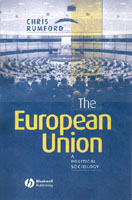 THE EUROPEAN UNION: a political sociology by Chris Rumford
Oxford: Blackwell, 2002. 320, £15.99, ISBN 0 631 22618 4
Readership: Advanced undergraduates, postgraduates, academic/research
Rating: ****
Reviewer: VASILIS MARGARAS(Loughborough University)
This book attempts an analysis of EU integration and EU policies through the prism of political sociology. In order to proceed with his basic aim, the author constructs a new notion of political sociology that overcomes national boundaries and can be applied to the EU. This is achieved through a process of incorporation of social theory and new sociology elements into his theory. Issues affecting the nature of identity, modernity and globalisation are also integrated into a vibrant text that questions current assumptions concerning EU integration. The book analyses the impact of globalisation on the EU, as well as issues concerning the present and future European state, European society and democracy. Issues of core-periphery relations, as well as the link between unemployment, social exclusion and citizenship, are also taken into consideration. In addition, EU policies such as cohesion policy and enlargement are analysed in depth.
“Cosmopolitanism and Europe” conference. Royal Holloway, University of London
 Plenary speakers: Ash Amin, Gerard Delanty, Eleonore Kofman, Ben Rosamond, Paul Statham, Nick Stevenson.
Other participants include: Barrie Axford, Daniele Archibugi, Larry Backer, Robert Fine, Andrew Geddes, Peter A. Kraus, Luke Martell, Maurice Roche.
In studies of the EU, discussion of cosmopolitanism is usually limited to questions of democracy and citizenship. In recent times, there has been a wider interest in cosmopolitanism in relation to civil society, the public sphere, EU polity, European identity, migration, transnational space, and multiculturalism. Indeed, cosmopolitanism is becoming a key concept for understanding social and political transformation in the contemporary context, offering an alternative way of conceptualizing community and belonging that does not rely upon the primacy of the nation-state.